St. Louis Cathedral, New Orleans, by Rafal Konieczny, 2004
Photo: No machine-readable author provided. Krakers assumed (based on copyright… / Wikimedia Commons · CC BY-SA 3.0

Audio walking tour

New Orleans Audio Walking Tour

The Crescent City

Stops
40
Core walk
33 of 40 stops within 1.5 mi of the center
Farthest stop
2.7 mi from the center
Start
Jackson Square
40 stops GPS-triggered audio No app download Free to start

Highlights

  • St. Louis Cathedral, New Orleans, by Rafal Konieczny, 2004
    St. Louis Cathedral

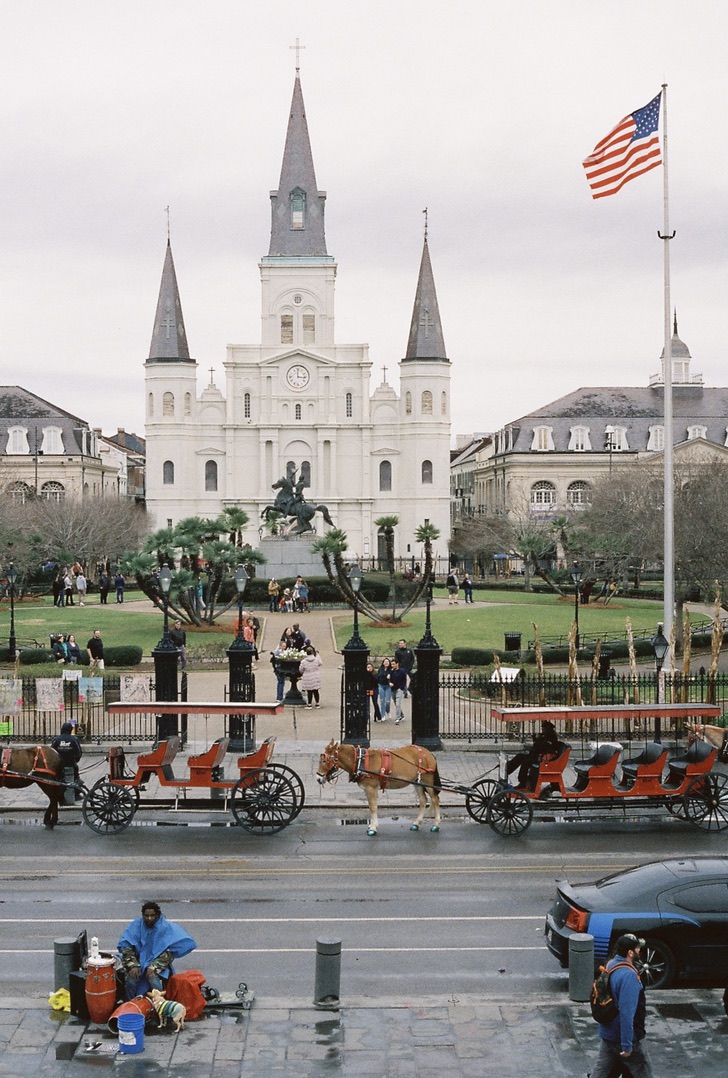
    St. Louis Cathedral anchors Jackson Square with its three steeples, the oldest continuously active cathedral in the United States and the spiritual heart of the city that built it. A church has stood on this spot since 1718, the year New Orleans was founded; the current building is the third on the site, constructed in 1794 after fire destroyed the second.

  • New Orleans, LA
    Café Du Monde

    Since 1862, Café Du Monde's open-air coffee stand has been serving beignets and café au lait from this very spot, and it may be the most beloved food destination in New Orleans. The menu has barely changed in 160 years: hot beignets dusted so heavily with powdered sugar that clouds of white drift across the table with every movement, paired with strong chicory coffee cut with hot milk.

  • National WWII Museum

    Congress has designated the National WWII Museum the official World War II museum of the United States, an institution that has grown from a single building into a multi-pavilion campus, among the most visited museums in the country and widely considered the finest WWII museum in the world. The museum was founded in 2000 by historian Stephen Ambrose, who chose New Orleans because the Higgins boat — the flat-bottomed landing craft that made the amphibious assaults at Normandy and across the Pacific possible — was designed and built here by Andrew Higgins and his Higgins Industries workforce.

  • Jackson Square, New Orleans. Featuring Andrew Jackson statue (center), the St. Louis Cathedral (center-back), horse-drawn tourist carriages (lower third), the American Flag (left). Shot on 35mm color film in January, 2023
    Jackson Square

    Notice the plaza at the heart of the oldest European settlement west of the Mississippi, platted by the French as the Place d'Armes in 1721. The French platted this plaza as the Place d'Armes in 1721, three years after the city's founding, designed as a military parade ground in the classic colonial grid with the river at its face and the church at its back.

  • New Orleans, LA
    Lafitte's Blacksmith Shop Bar

    Low, brick, and easy to miss, Lafitte's Blacksmith Shop is believed to be the oldest bar in the United States, a structure that has survived two and a half centuries of New Orleans history largely by not calling too much attention to itself. The building dates to somewhere between 1722 and 1732, making it one of the oldest surviving structures in the French Quarter, built in the briquette-entre-poteaux technique — bricks set between wooden posts — that was standard in French colonial Louisiana before the great fires.

All 40 stops

  • Jackson Square (French Quarter)

    Notice the plaza at the heart of the oldest European settlement west of the Mississippi, platted by the French as the Place d'Armes in 1721.

  • St. Louis Cathedral (French Quarter)

    St. Louis Cathedral anchors Jackson Square with its three steeples, the oldest continuously active cathedral in the United States and the spiritual heart of the…

  • The Cabildo (French Quarter)

    Inside the Cabildo, the United States doubled its size.

  • The Presbytère (French Quarter)

    Across the face of St. Louis Cathedral, the Presbytère mirrors the Cabildo, completing the formal symmetry of Jackson Square's most historic elevation.

  • Pontalba Buildings (French Quarter)

    Micaela Almonester de Pontalba's twin red-brick buildings frame two sides of Jackson Square, the oldest apartment buildings in the United States, their iron-lace balconies defining…

  • Café Du Monde (French Quarter)

    Since 1862, Café Du Monde's open-air coffee stand has been serving beignets and café au lait from this very spot, and it may be the…

  • French Market (French Quarter)

    Under the covered sheds along the riverfront, you have reached one of the oldest public markets in the United States, the trading heart of New…

  • Bourbon Street (French Quarter)

    Bourbon Street is the most famous street in New Orleans, a name that conjures the city's reputation for pleasure and excess in the American imagination.

  • Royal Street (French Quarter)

    One block over from Bourbon Street, Royal Street shows you the French Quarter's other face: refined, artistic, and, by many accounts, the most beautiful street…

  • Preservation Hall (French Quarter)

    Preservation Hall, the modest building in front of you, is one of the most important music venues in American history, having done more to preserve…

  • Antoine's Restaurant (French Quarter)

    Antoine's has served French-Creole cuisine continuously from this location since 1840, making it the oldest restaurant in the United States, a survivor of the Civil…

  • Lafitte's Blacksmith Shop Bar (French Quarter)

    Low, brick, and easy to miss, Lafitte's Blacksmith Shop is believed to be the oldest bar in the United States, a structure that has survived…

  • Old Absinthe House (French Quarter)

    At the corner of Bourbon and Bienville, the Old Absinthe House has been serving spirits since 1806, one of the most storied drinking establishments in…

  • Old Ursuline Convent (French Quarter)

    Few buildings in the United States are older than the Old Ursuline Convent, the oldest surviving building in the Mississippi River valley.

  • Beauregard-Keyes House (French Quarter)

    Two remarkable figures, across different centuries, called this raised center-hall Creole cottage home, and you are looking at one of the finest examples of the…

  • St. Louis Cemetery No. 1 (French Quarter / Tremé)

    Above-ground tombs fill the one square block you face here, the oldest surviving cemetery in New Orleans, established in 1789.

  • Marie Laveau's House (French Quarter)

    Marie Laveau, the most powerful and mysterious woman in New Orleans history, lived near this spot — a figure who combined genuine spiritual authority, extraordinary…

  • Congo Square (Tremé / Armstrong Park)

    Congo Square is the birthplace of American music.

  • Louis Armstrong Park (Tremé)

    Louis Armstrong Park honors the man who took the musical tradition of Congo Square and carried it to the world.

  • Tremé Neighborhood (Tremé)

    Small as it is, the Tremé is the oldest African American neighborhood in the United States, a community that has shaped American culture to a…

  • St. Augustine Church (Tremé)

    Founded in 1841, St. Augustine Church is recognized as the oldest African American Catholic church in the United States, a building that embodies the complex…

  • Backstreet Cultural Museum (Tremé)

    Housed in a former funeral home, the Backstreet Cultural Museum is one of the most important small museums in the United States, preserving the living…

  • Frenchmen Street (Faubourg Marigny)

    Serious music lovers in New Orleans have long considered Frenchmen Street the authentic alternative to Bourbon Street's tourist-oriented spectacle — a three-block stretch of bars…

  • Faubourg Marigny (Faubourg Marigny)

    Faubourg Marigny — faubourg is the French word for suburb — began as the plantation of Bernard de Marigny, one of the most colorful characters…

  • Bywater (Bywater)

    Downriver from the Marigny, Bywater has become the most energetic creative enclave in post-Katrina New Orleans — a working-class riverside district of shotgun houses, corner…

  • Esplanade Avenue (Tremé / Esplanade Ridge)

    Esplanade Avenue was once the grandest residential boulevard in Creole New Orleans, a wide, oak-canopied avenue lined with antebellum mansions that served as the Creole…

  • Basin Street (Tremé / Central City)

    Basin Street gave jazz one of its most famous anthems.

  • Storyville District Site (Central City / Tremé)

    From 1897 to 1917, Storyville, the district that gave American music its founding legend, operated near where you are now.

  • St. Charles Avenue Streetcar (Uptown)

    Green wooden cars have rattled along St. Charles Avenue since 1835 with only brief interruptions, making this the oldest continuously operating streetcar line in the…

  • Garden District (Garden District)

    American architects consider the Garden District one of the finest concentrations of antebellum residential architecture in the country, built by the American merchants and planters…

  • Commander's Palace (Garden District)

    Commander's Palace, the turquoise Victorian building at the corner of Washington Avenue and Coliseum Street, is one of the most celebrated restaurants in the United…

  • Lafayette Cemetery No. 1 (Garden District)

    Lafayette Cemetery No. 1 has occupied this block since 1833, the Garden District's answer to the French Quarter's St. Louis cemeteries — a walled city…

  • Magazine Street (Uptown / Garden District)

    Six miles of shops, cafes, and galleries run parallel to the river along Magazine Street, the shopping, dining, and cultural spine of Uptown New Orleans…

  • Warehouse / Arts District (Warehouse District)

    Nineteenth-century cotton warehouses and commercial buildings fill the Warehouse District, transformed beginning in the 1980s into New Orleans' dense concentration of galleries, museums, restaurants, and…

  • Ogden Museum of Southern Art (Warehouse District)

    Nowhere in the United States is Southern visual art presented more comprehensively than at the Ogden Museum, a collection that gives the art of the…

  • National WWII Museum (Warehouse District)

    Congress has designated the National WWII Museum the official World War II museum of the United States, an institution that has grown from a single…

  • Crescent Park (Bywater / Marigny)

    Crescent Park opened in 2014, a 1.4-mile linear riverfront park on land that had been occupied by industrial rail infrastructure for more than a century…

  • Fair Grounds Race Course (Mid-City / Gentilly)

    Every spring, the Fair Grounds — a thoroughbred racing venue operating since 1852 and one of the oldest in the United States — becomes the…

  • City Park (Mid-City)

    City Park spreads across 1,300 acres of live oaks, lagoons, botanical gardens, golf courses, and cultural institutions, one of the largest urban parks in the…

  • New Orleans Museum of Art (City Park)

    Set at the end of a long allée of live oaks in City Park, the New Orleans Museum of Art is a Beaux-Arts building that…

How it works

1

Open on your phone

No download. Works in Safari or Chrome.

2

Start walking

Head toward any historic stop. No fixed route.

3

Audio plays itself

Walk within range of a stop and the story begins.

Open the New Orleans tour →

Three stops free. No account needed.

Gear for walking New Orleans

We earn a commission from purchases made through these links.