
Audio walking tour
Gettysburg Audio Walking Tour
Gettysburg: Where Past Voices Guide Your Steps
- Stops
- 20
- Core walk
- 19 of 20 stops within 1.5 mi of the center
- Farthest stop
- 1.6 mi from the center
- Start
- Gettysburg Railroad Station
Highlights
-
Gettysburg College
Founded in 1832 as Pennsylvania College, Gettysburg College spreads its campus in front of you. Founded in 1832 as Pennsylvania College by Samuel Simon Schmucker, this institution began as a sister school to the Lutheran Theological Seminary — the seminary that is now a campus of the United Lutheran Seminary.
-
Gettysburg National Cemetery
Gettysburg National Cemetery, originally called Soldiers' National Cemetery, opens in front of you, a United States national cemetery created for Union army casualties of the Battle of Gettysburg during the American Civil War. In the summer of 1863 that battle raged over three days, July 1 to 3, and proved both the Civil War's deadliest and its most significant engagement, resulting in over 50,000 casualties — the most of any battle in the Civil War and in American military history.
-
Gettysburg Cyclorama
Curving a full 360° in front of you, the Gettysburg Cyclorama by French artist Paul Dominique Philippoteaux depicts Pickett's Charge, the climactic Confederate attack on Union forces at the Battle of Gettysburg on July 3, 1863. Commissioned by Chicago investors, Philippoteaux studied the battlefield and interviewed participants before completing the cyclorama in 1883.
-
 The Angle
Here at the Angle, sometimes called the Bloody Angle, you face the Copse of Trees—the 1863 landmark used as the target for Pickett's Charge—the 1892 monument marking the high-water mark of the Confederacy, a rock wall, and several other Battle of Gettysburg monuments. On July 3, 1863, roughly 1,500 Confederate Virginians broke through the Union line on Cemetery Ridge here, an intense moment that left this small place so central to memory.
-
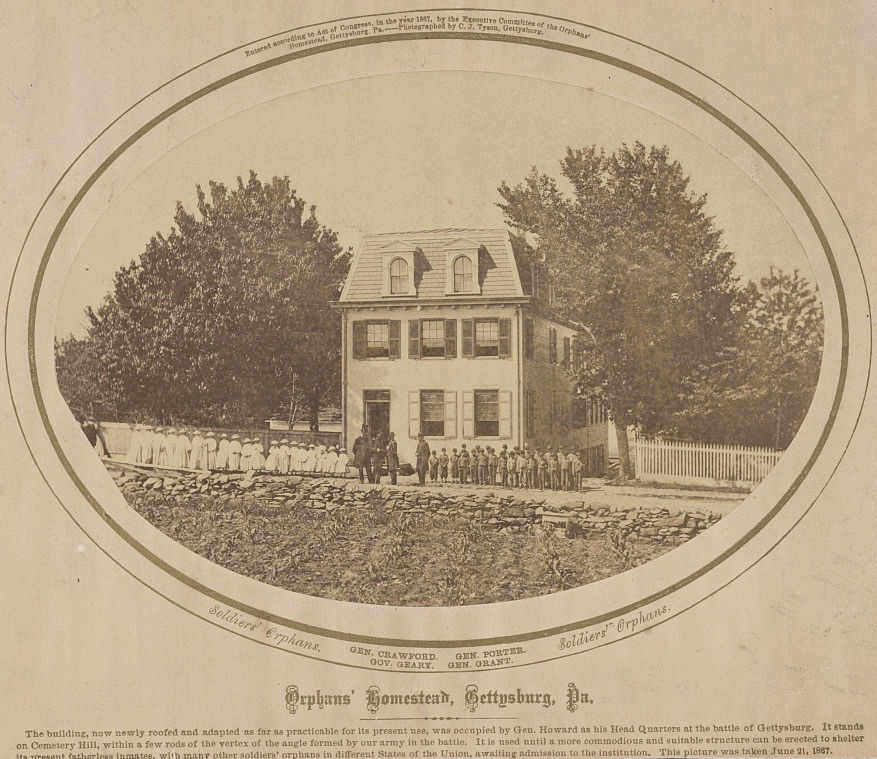 National Homestead at Gettysburg
Picture 777 Baltimore Street at the north foot of Cemetery Hill, where the Gettysburg Orphanage once opened its doors to war orphans. Once opened in October 1866 and incorporated March 22, 1867, this building began life as the Gettysburg Orphanage and a widows' home founded by Dr. John F. Bourns after fundraising sparked by the identification of a Battle of Gettysburg casualty's children as Amos Humiston's.
All 20 stops
- Gettysburg Railroad Station (Gettysburg Battlefield Historic District)
- Adams County Courthouse (Gettysburg)
- National Homestead at Gettysburg (Cemetery Hill)
- Evergreen Cemetery gatehouse (Evergreen Cemetery)
- Evergreen Cemetery (Cumberland Township)
- Gettysburg National Cemetery (Gettysburg)
- Soldiers' National Monument (Gettysburg National Cemetery)
- Gettysburg Rostrum (Gettysburg National Cemetery)
- The Angle (Gettysburg)
- High Water Mark of the Rebellion Monument (Gettysburg Battlefield)
- 1st Minnesota Infantry Monument (Cemetery Ridge)
- The Pennsylvania State Memorial (Cemetery Ridge)
- Gettysburg National Military Park Museum and Visitor Center (Gettysburg)
- Gettysburg Cyclorama (Gettysburg National Military Park)
- McPherson Ridge (Gettysburg)
- Lutheran Theological Seminary at Gettysburg (Gettysburg)
- Schmucker Hall (Seminary Ridge)
- Gettysburg College (Gettysburg)
- Pennsylvania Hall (Gettysburg)
- Virginia Monument (Gettysburg National Park)
How it works
Open on your phone
No download. Works in Safari or Chrome.
Start walking
Head toward any historic stop. No fixed route.
Audio plays itself
Walk within range of a stop and the story begins.
Three stops free. No account needed.
Gear for walking Gettysburg
We earn a commission from purchases made through these links.